The project: DIY camper furniture in aluminium and wood
- Frame
- 3030 aluminium
- Panels
- Poplar and birch
- Thickness
- 9 mm
- Solution
- Hybrid
Contents
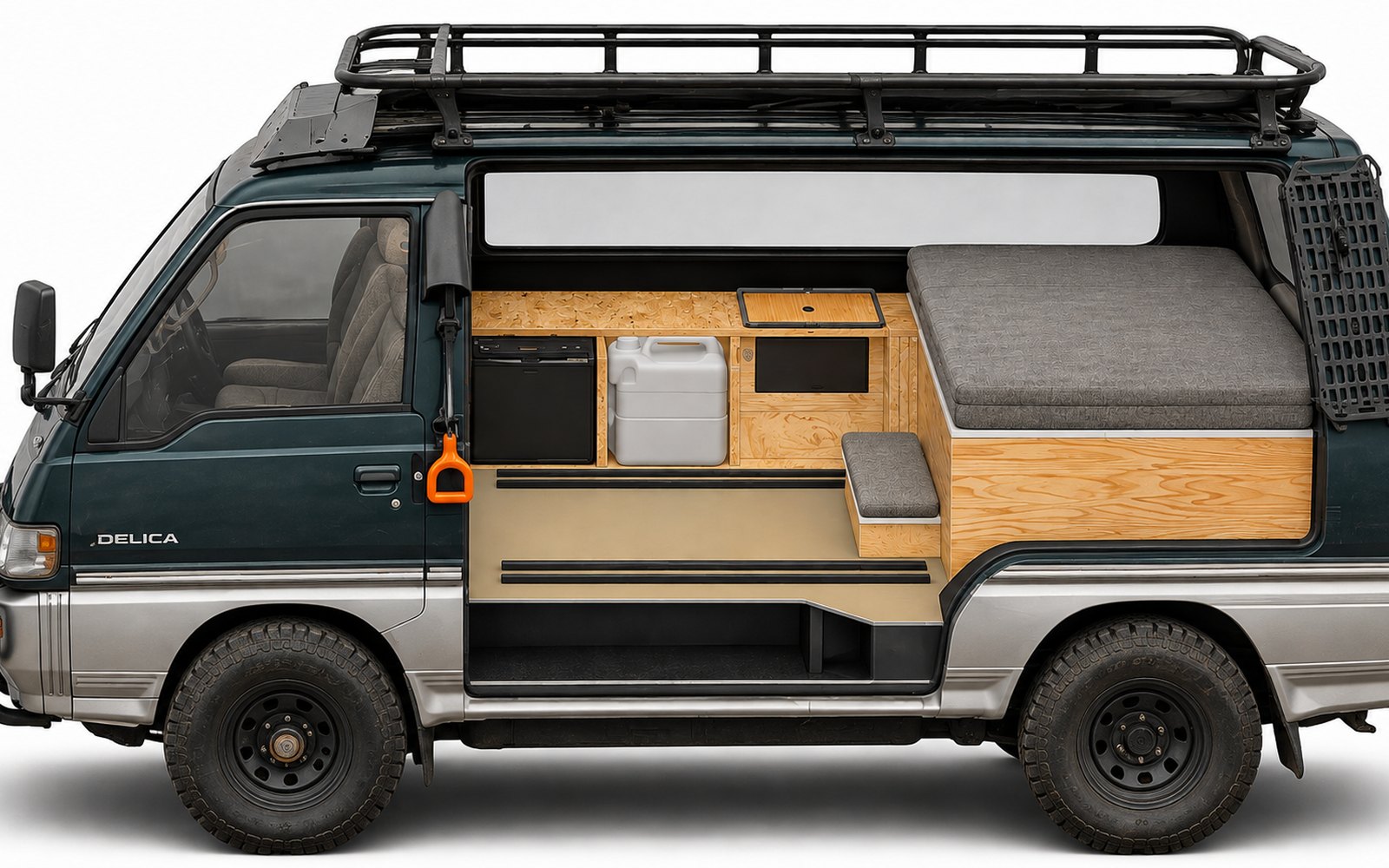
When I started designing the interior of my Mitsubishi Delica L300 4x4, I wanted to create a camper conversion that was robust, lightweight and, above all, modular.
The Delica is a compact van and every centimetre counts. I needed to fit a pull-out bed, a fridge, a small sink, the utility systems and several storage compartments without sacrificing too much living space.
One of the first decisions was which materials to use for the furniture: entirely plywood, or an aluminium-profile structure with wooden panels?
In the end I chose a hybrid solution, mainly using 3030 aluminium profiles, 9 mm poplar plywood and 9 mm birch for the more highly stressed parts.
Wooden camper furniture or 3030 aluminium: which is more worthwhile?
Both solutions have advantages and disadvantages. Wood is probably the most common material in DIY camper conversions, while aluminium profiles are an interesting alternative for anyone looking for modularity and ease of modification.
Here is a practical comparison:
| Feature | Furniture made entirely of wood | 3030 aluminium frame + wood |
|---|---|---|
| Weight | Potentially very light with poplar plywood | Depends on the number of profiles; not necessarily lighter |
| Cost | Generally lower | Generally higher because of the profiles and connectors |
| Strength | Excellent when properly designed and assembled | Good rigidity, but depends on joints and bracing |
| Assembly | Requires precise cuts and woodworking | Modular assembly with brackets and T-nuts |
| Later modifications | Often require new cuts or panels | Easier to modify or extend the structure |
| Disassembly | Depends on the assembly method | Generally simple thanks to bolted connections |
| Moisture resistance | Requires protection for surfaces and edges | Corrosion-resistant profiles; panels still need protection |
| Vibrations and rough tracks | Excellent with suitable joints and fixings | Good, but connections must be designed to prevent loosening |
| Footprint | Can make use of thin structural panels | The 30 mm profiles take up space |
| Appearance | More traditional and uniform look | Technical look, customisable with cladding |
So which solution is best?
There is no single answer that works for everyone.
If the goal is to build economical, lightweight and relatively simple furniture, poplar plywood can be an excellent choice.
If instead you want a structure that is easy to modify, dismantle and access for maintenance, aluminium profiles can offer interesting advantages.
For my Delica, I prioritised the latter above all.
Why I chose 3030 aluminium profiles
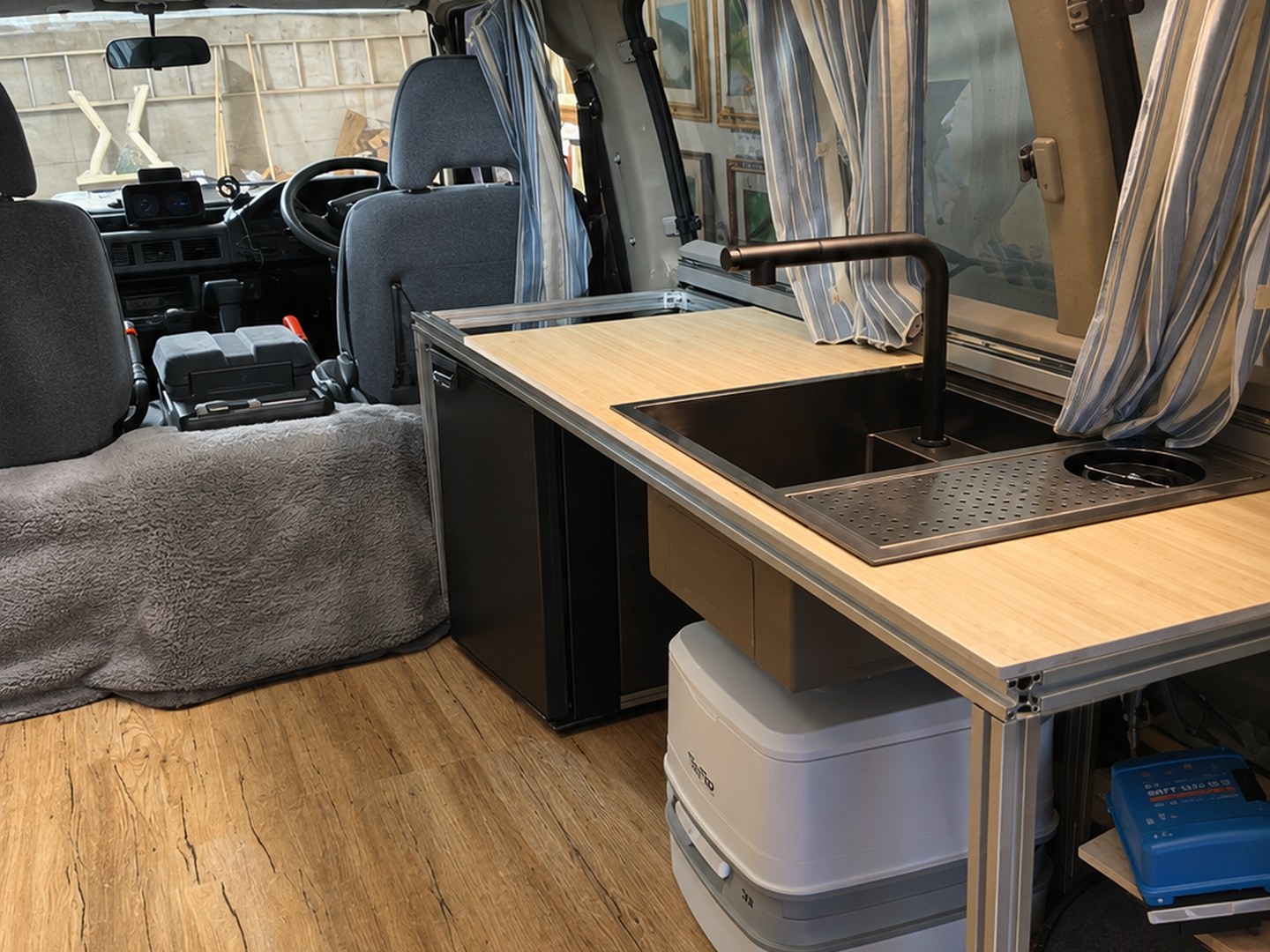
I mainly used 30 × 30 mm structural aluminium profiles, assembled with dedicated connectors.
The feature that convinced me most was their modularity.
During a DIY camper conversion it is normal to change the design, move a component or realise that a space could be used more effectively.
With a 3030-profile structure I can make changes more easily without having to rebuild entire sections of furniture.
The bolted connections also let me remove panels to reach electrical systems, pipework and other components.
This is particularly important for a vehicle intended for overlanding, where ease of maintenance is a priority.
Poplar and birch plywood: why I used both
To complete the furniture I chose two different materials, both 9 mm thick.
Poplar plywood
I used it mainly for cladding and less highly stressed parts. It is relatively light, easy to work with and helps keep the overall weight of the conversion down.
Birch plywood
For the more structural parts I preferred birch, which is generally denser and more rigid than poplar.
The idea was to use the stronger material only where necessary, avoiding adding unnecessary weight to the furniture.
Felt lining
I then covered the wood and some parts of the van with a self-adhesive felt bought on AliExpress, the kind used to line speakers and subwoofers: it is easy to apply and gives the furniture a more uniform finish.
Naturally, 9 mm thickness is not suitable indiscriminately for every load-bearing element: strength also depends on the unsupported span, the supports and the expected load.
How I organised the space inside the Delica
The project had to include everything needed to travel and sleep inside the Delica while keeping the space practical and accessible.
I therefore planned a pull-out bed, space for the fridge, a small sink, compartments for the utility systems and several storage compartments.
The aluminium structure allowed me to adapt the furniture dimensions to the available space and include removable panels for maintenance.
Materials used
These are the main materials I used, with links to find them on Amazon.
| Material | Amazon link |
|---|---|
| 3030 aluminium profiles | View on Amazon |
| Brackets for 3030 profiles | View on Amazon |
| T-nuts for 3030 profiles | View on Amazon |
| 9 mm poplar plywood | View on Amazon |
| 9 mm birch plywood | View on Amazon |
| Self-adhesive felt (AliExpress) | View on AliExpress |
Some of these are affiliate links: if you buy through them I may receive a commission, at no additional cost to you. The links lead to Amazon searches. Before buying profiles and accessories it is important to check their compatibility, because not all 3030 systems use the same grooves and connectors.
My choice for a 4x4 camper
After weighing up the alternatives, I am happy with my choice to combine aluminium and wood.
It is not necessarily the cheapest system or the lightest overall, but it offers the flexibility I wanted for a camper conversion designed to evolve over time.
My priority is to build a robust vehicle that is easy to repair and suited to travelling away from paved roads.
Naturally, achieving a truly strong result also requires carefully designing how the furniture is fixed to the vehicle.
In the next articles I will cover the thermal insulation, pull-out bed and on-board systems of my Mitsubishi Delica L300.
- #mobili camper fai da te
- #alluminio 3030
- #legno o alluminio camper
- #multistrato di pioppo
- #multistrato di betulla
- #camperizzazione Delica L300