JDM registration in Italy: how I got Italian plates for my Mitsubishi Delica L300 for €1,300
How I registered a 1991 JDM Mitsubishi Delica L300 imported from Germany in Italy: from the attempt at historic registration to the discovery of a replaced engine, all the way to Italian plates obtained without a physical inspection.
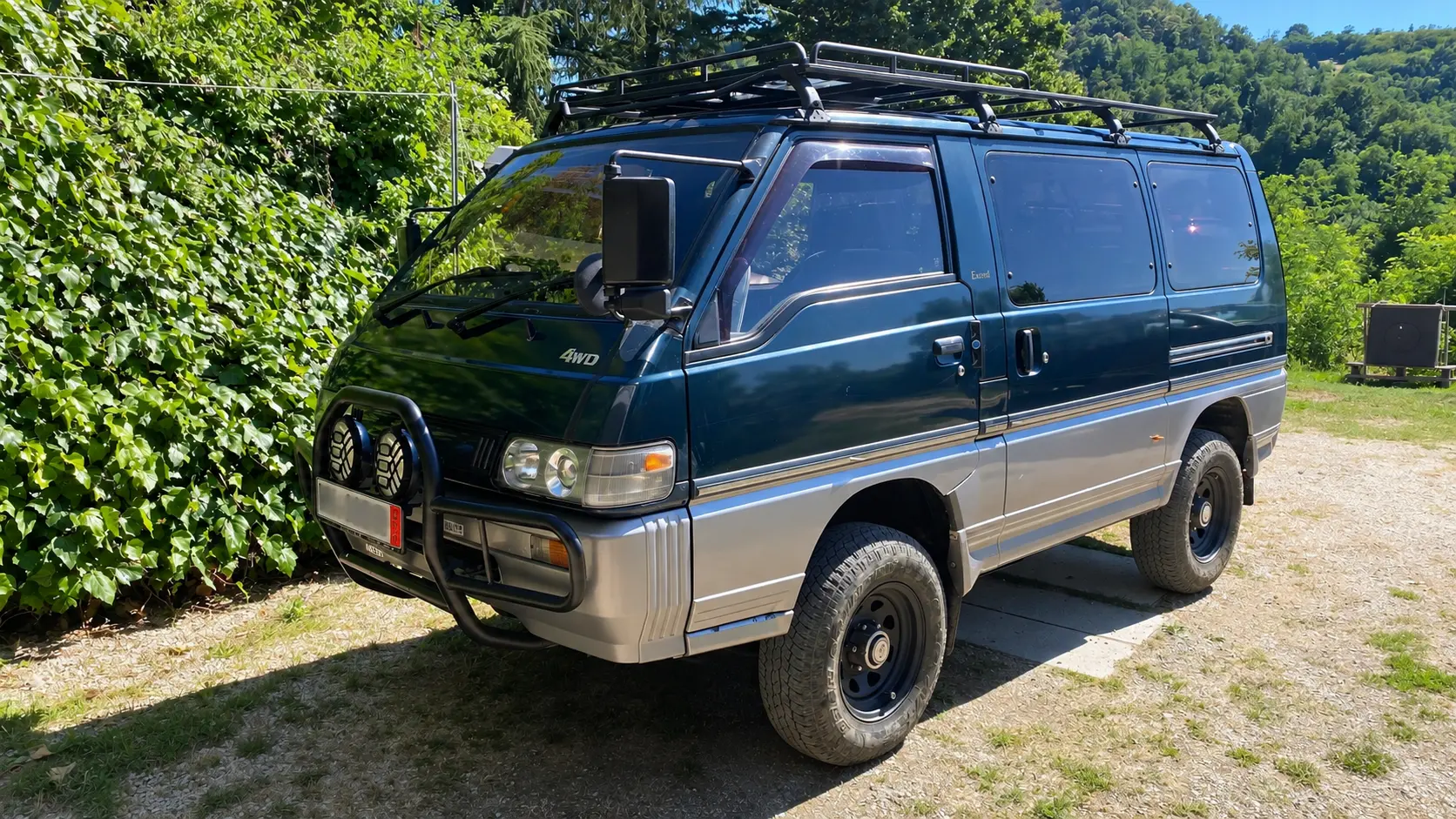
- Cost
- ≈ €1,300
- Duration
- ≈ 5 months
- Inspection
- Not required
- Engine
- Hyundai D4BH
Contents
When I bought my 1991 JDM Mitsubishi Delica L300 in Germany in April 2026, I knew one of the biggest challenges would be registering it in Italy.
The Delica was already properly registered in Germany, but it was still a vehicle originally built for the Japanese market, right-hand drive, with technical details that are not always easy to document through the usual European procedures.
After driving it back to Italy on German temporary plates, I had one last bureaucratic step left: getting the Italian registration document and plates.
For the whole procedure I relied on Car4Passion, who followed me from start to finish and helped me solve an unexpected problem that came up when the paperwork was almost done.
In the end, about five months after buying it, I registered my Delica in Italy as a regular seven-seat passenger car, spending about €1,300 all included and without a physical inspection at the Motorizzazione.
Here is how it went.
Registering a JDM car in Italy: where to start?
My Mitsubishi Delica L300 is a JDM vehicle (Japanese Domestic Market), meaning it was originally intended for the Japanese home market.
So, even though it had already been registered in Germany, it did not necessarily come with the same type-approval documents as a vehicle originally sold in Europe.
The Italian registration therefore required a careful check of the German documents and of the vehicle's technical characteristics.
That is why I chose to rely on specialists instead of handling the whole procedure myself.
First attempt: registration as a historic vehicle
First registered in 1991, my Delica was already more than thirty years old.
Together with Car4Passion, we initially decided to go down the route for vehicles of historic interest.
The idea was to get the vehicle recognised as historic and use that in the subsequent Italian registration.
The paperwork was already well advanced when a problem we had not considered came up.
The engine was not the original one.
The replaced engine problem: Mitsubishi 4D56 and Hyundai D4BH
Almost at the end of the historic procedure, we realised my Delica had a different engine from the original.
The Mitsubishi Delica L300 2.5 turbodiesel comes with an engine from the Mitsubishi 4D56 family, while mine had a Hyundai D4BH, a turbodiesel closely related to the Mitsubishi unit.
The D4BH is in fact a Mitsubishi-derived Hyundai engine, also used in vehicles such as the Hyundai Galloper and H-1.
Mechanically, the two engines belong to a very similar technical family. In terms of identification and historic originality, though, the different engine code could be a problem.
To obtain historic-interest recognition, the vehicle's conformity to its original configuration can be important.
We had no certainty that the replaced engine was compatible with the route we had chosen and, above all, we did not want to risk later complications.
So we decided to change course.
From historic registration to ordinary registration
With Car4Passion we chose to drop the historic route and go for a regular registration as a passenger car.
That meant handling the paperwork through a different procedure, based on the vehicle's technical documentation.
The solution was to have the technical documents needed for the Italian registration prepared in Germany.
German technical documentation to register a JDM car
One of the main difficulties in registering a Japanese car is the availability of technical data.
Depending on the model and its history, documents normally used for European vehicles may be missing, or specific technical certifications may be needed.
In my case, Car4Passion coordinated the preparation of the documents in Germany, which were then sent to the Italian Motorizzazione.
The technical information relevant to the procedure included:
- Vehicle and engine identification.
- Displacement and power.
- Weights and dimensions.
- Wheelbase and track widths.
- Braking system characteristics.
- Tyres and their specifications.
Thanks to the documents produced and accepted by the relevant offices, we were able to continue with the ordinary procedure.
JDM registration without an inspection at the Motorizzazione
One of the best surprises came right at the end.
In my case I did not have to physically take the Delica to the Motorizzazione for a technical inspection.
The documents submitted were enough to complete the registration, without requiring a further visit and test of the vehicle.
That was a huge advantage, especially for a vehicle over thirty years old, right-hand drive and with a replaced engine.
Of course this does not mean every JDM car can be registered without an inspection: each case depends on the available documents, the vehicle's characteristics and the assessment of the relevant offices.
In my case, though, no extra trip with the Delica was needed for an inspection.
And even more convenient: once the procedure was completed, the Italian plates were shipped straight to my home.
After months of waiting, the Delica finally had its Italian plates.
How much does it cost to register a JDM car in Italy?
One of the most important questions for anyone wanting to import a Japanese car is how much Italian plates actually cost.
In my case, registering the JDM Mitsubishi Delica L300 imported from Germany cost about €1,300 all included.
That amount covered handling the procedure, the technical documents prepared in Germany and obtaining the Italian plates.
Considering that we had to completely change strategy during the procedure, moving from the historic route to the ordinary one, I think the price was really fair.
To give an idea of the overall project costs:
| Item | Cost |
|---|---|
| Buying the Mitsubishi Delica L300 in Germany | €4,000 |
| Italian registration with Car4Passion | About €1,300 |
| Total purchase + registration | About €5,300 |
On top of this come the costs of the transfer from Germany, including the German temporary plates, insurance for the trip, fuel and any tolls.
Of course, the €1,300 is the cost of my case, not a standard rate for every JDM car.
Car4Passion: my experience registering an imported car
I want to dedicate part of this article to Car4Passion, because their help was essential.
From the start they helped me choose the most suitable registration procedure for my Mitsubishi Delica L300.
When we found out the engine had been replaced, the historic paperwork was almost complete. It would have been easy to end up in a difficult situation, at risk of starting all over again without knowing how to proceed.
Instead, together with them, we found an alternative solution.
They coordinated the technical documents in Germany and followed the procedure until the Italian plates arrived.
I especially appreciated their availability, their professionalism and their ability to find a solution even in the face of an unexpected problem.
And above all I found their prices genuinely fair, considering the complexity of the procedure and the work involved.
Based on my personal experience, I would absolutely recommend them to anyone facing an unusual registration, especially JDM cars or vehicles imported from abroad.
How long does it take to register a Japanese car in Italy?
In my case, the procedure took about five months.
This was the timeline:
| Period | What happened |
|---|---|
| April 2026 | Bought the Delica in Germany and drove it to Italy |
| First phase | Started the historic recognition procedure |
| During the procedure | Discovered the replaced Hyundai D4BH engine |
| Second phase | Switched to ordinary registration and German technical documents |
| September 2026 | Received the Italian registration document and plates |
The time needed to register a car imported from Germany can vary a lot depending on the vehicle and the available documents.
In my case, the change of procedure certainly made the process more complex.
Is it worth importing and registering a JDM car in Italy?
After this experience, my answer is yes, but you need to pay attention to what you buy.
Importing a JDM car can let you find rare models, unusual trims and vehicles that are hard to find on the Italian market.
My Mitsubishi Delica L300 is one example.
At the same time, it is essential to check the documents and the actual possibility of registration in advance.
A seemingly minor detail, like a different engine code, can change the bureaucratic path.
My advice to anyone wanting to buy a JDM Mitsubishi Delica, a Japanese Toyota Land Cruiser or any other imported vehicle is to talk to a professional before closing the deal.
In my case, relying on Car4Passion was a choice I would make again.
For about €1,300 I got the Italian registration, the necessary documents and the plates delivered home, without a physical inspection of the vehicle.
Since September 2026 my JDM Mitsubishi Delica L300 has finally been registered in Italy as a seven-seat passenger car.
And now I can focus on what really interests me: turning it into a robust, reliable 4x4 camper, ready for future overlanding trips.
Related articles
- The full story of my Delica L300: how I found and bought it in Germany.
- Importing a car from Germany: export plates: documents, insurance and the drive home.
- #Immatricolazione JDM Italia
- #Immatricolare auto giapponese
- #Costo immatricolazione JDM
- #Immatricolazione auto dalla Germania
- #Auto storica importata
- #Immatricolazione senza collaudo
- #Mitsubishi Delica